
This month shouldn't be about ranking points (for most teams)
Higher rankings are better when it comes to the World Cup draw, but at this point of the cycle, most teams should already know what pot they will be in.

This week, I am looking at World Ranking points and how much teams should worry about it just before the next World Cup draw. I’ve taken Dimitri Perrin’s work as inspiration and I would recommend reading through it to not only understand how it works but to also get a feel for what really matters. He does a great job, and I would completely understand if you didn’t bother reading any further.
If you are sticking with me but wondering why I’m focusing on it now, lately I have noticed how often coaches and players are noting the importance of ranking points and therefore the need to win. And this is filtering down to the media and fans, or at least that is what Reddit users’ comments suggest. Thing is, with only two or three matches left in the cycle, not much can change.
Quick intro to ranking points
World Rugby maintains rankings for both the men’s and women’s game and these are updated after each week’s matches. Each team has a score which is based on past results. How many points they win or lose after a game depends on the score and the difference in ranking points between the team and their opposition.
The points won/lost is a zero-sum game. If a team gains a point then their opposition loses a point.
The rankings do account for home advantage, with bigger potential gains for the away team.
5 score scenarios are considered
Home Team wins by more than 15 points
Home Team wins by 15 or fewer points
A draw
Away Team wins by 15 or fewer points
Away Team wins by more than 15 points
If the teams had the same number of points before the match, then the possible outcomes would be something like:
There is no allowance for close wins or loses. If you only just lose, even to a team much higher ranked, then you won’t win any points.
Of course, teams don’t go in with the same number of ranking points. Therefore, the scores are biased towards the lowered ranked team, i.e. higher ranked teams can win fewer points than the lower ranked team. For example, this weekend Italy are at home to Australia who are higher ranked. The possible point outcomes are:
Italy win by more than 15 points, Italy gain 1.82 points and Australia lose 1.82.
Italy win by 15 points or fewer, Italy gain 1.21 points and Australia lose 1.21.
A draw, Italy gain 0.21 points and Australia lose 0.21.
Australia win by 15 points or fewer, Italy lose 0.79 points and Australia gain 0.79.
Australia win by 15 points or fewer, Italy gain 1.18 points and Australia lose 1.18.
If the difference between the teams is wide enough, the higher ranked team cannot gain any points and therefore the losing team cannot lose any. For example, Ireland play Japan this weekend with no hope of gaining any points but could lose up to 3 points (which Japan would gain).
It’s not that straightforward (see here for the official description) but the big thing to take away is that matches between teams who are closely ranked have fewer points at stake than when one team is much more lowly ranked.
What’s at stake this November?
The World Cup draw is scheduled for 3rd December, where teams will be drawn to fill the 6 competition pools. The 6 top ranked teams will be the 1st seeds for each pool, the next 6 will be the 2nd seeds and so on. To give you the best chance of an easier pool you want to be as high a seed as possible. For this reason, many of the world’s top teams are talking about the importance of being in the top 6 by the end of the month.
Of course, the ranking will be based on much more than what happens this month and so some teams are much better placed than others. With a lens on Australia’s chances of making the top 6, Dimitri has run simulations to produce probabilities for all the major nations.
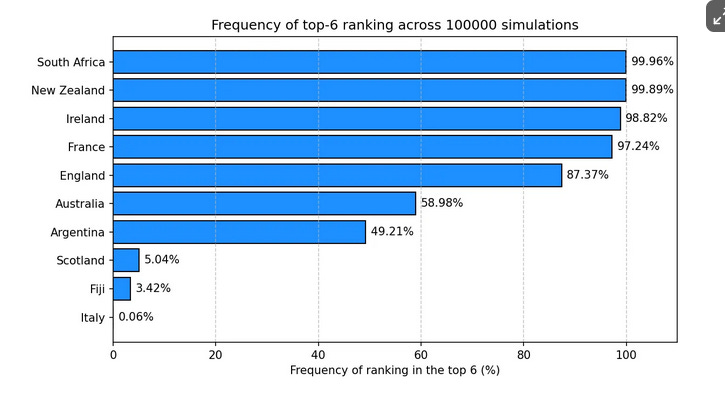
As you can see, South Africa, New Zealand, Ireland and France came into November very likely to make the top 6. England would also likely be there, leaving a single spot for Australia and Argentina to fight for. Dimitri has also looked at next 6 places and concluded they are very likely to be filled by Australia/Argentina, Scotland, Fiji, Italy and 2 of Japan, Wales and Georgia.
When you look at these probabilities, you realise that many teams don’t actually have much on the line this month. Australia and Argentina are in a battle for the 6th spot, while Japan have a couple of big matches against Georgia and Wales.
How should teams approach the month
Teams and players are mentioning ranking points as a reason for taking the matches seriously, but in reality there is little at risk and teams can focus on issues such as player and squad development instead.
1. South Africa
Opponents: France, Italy, Ireland, Wales
Basically already guaranteed of making the top 6. They should enjoy the tour, try to keep winning while making the most of the opportunity to experiment with either personnel or tactical changes.
2. New Zealand
Opponents: Scotland, England, Wales
They have the not small matter of a tour grand slam on the line. That should motivate them enough while they continue to bed in new players and partnerships. World ranking points should not be a factor.
3. Ireland
Opponents: Japan, Australia, South Africa
Probably the country that has mentioned ranking points the most, they have a very small chance of falling out of the top 6. Ironically, because of the way points are awarded, beating Japan by a point or 40 is most important, as not doing so would have the biggest hit on their ranking points. Winning clearly has value (prestige, good vibes) but there are opportunities for experimentation this month, whether the coaching team take them or not.
4. England
Opponents: Fiji, New Zealand, Argentina
Don’t lose to Fiji. It should be that simple, but Fiji have recent history in this fixture. If England win, they then can focus on derailing New Zealand’s Grand Slam attempt before an always friendly match with Argentina.
5. France
Opponents: South Africa, Fiji, Australia
Their ranking has slipped a little after a few loses to New Zealand in the summer, but they are largely in the same boat as England—don’t lose to Fiji. France are usually more conservative in their autumn selections than on summer tours and so expect some strong performances. This week’s match with SA could be incredible, as both teams have little to lose.
6. Argentina
Opponents: Wales, Scotland, England
A classic Great Britain road trip for the Pumas, they need to win in Wales to give themselves a good chance of a top 6 finish. If they don’t they can settle for being a 2nd seed in the draw and then just try winning matches for the sake of winning being good.
7. Australia
Opponents: Italy, Ireland, France
Unsurprisingly similar to Argentina, but with Italy instead of Wales. Depending on how Argentina do, Ireland could be Australia’s pivotal match—win and they will be a good place, but losing could leave them desperate to beat France.
8. Scotland
Opponents: New Zealand, Argentina, Tonga
Basically nothing on the line when it comes to the World Cup draw. They are almost certain to be 2nd seeds and so should look to turn Murrayfield into a fortress before experimenting against Tonga.
9. Fiji
Opponents: England, France
Two free hits against higher ranked teams. They basically can’t lose points in these matches and so can enjoy continuing to prove they belong at the top table and should play in a high profile annual tournament to match.
10. Italy
Opponents: Australia, South Africa, Chile
Italy tend to pick quite conservatively (small playing pool and need to build cohesion/momentum) and will be focused on the big scalps of Australia and South Africa. What they do against Chile will be interesting—experiment more than usual or ensure a good win to build towards the 6 Nations?
11. Georgia
Opponents: USA, Canada, Japan
Regarding ranking points, there is little to gain and quite a lot to lose against the USA and Canada, but the Japan match is the big one. Depending on how Japan do against Wales, this result could lead to a significant swing in ranking points and who are 2nd seeds in the draw.
12. Wales
Opponents: Argentina, Japan, New Zealand, South Africa
If there is one benefit to dropping like a stone through the rankings, it is playing against the top sides provides opportunity with very little risk of loss. I’ve not checked the potential point swings for the matches against Argentina, New Zealand and South Africa but I would be surprised if Wales can lose any points. A win in one of these matches will probably confirm them as a 2nd seed. However, lose all four matches and they could be the 3rd seed nobody wants.
13. Japan
Opponents: Ireland, Wales, Georgia
Japan probably find themselves with the most consequential schedule this month. Winning two matches will probably get them a second seed, but Ireland will be keen to win to confirm their 1st seed while Wales and Georgia will be equally desperate for a second seed. I don’t know how, but Eddie Jones finds himself front and centre once again (at least from a rankings perspective.
So there you have it. Teams have many reasons for wanting to win (mostly because they like doing it) but not many have ranking points to worry about. If coaches outside of Australia, Argentina, Georgia, Wales and Japan do say they are concerned about ranking points I hope it is because they are using it as an excuse for not developing players and squad depth—otherwise they fundamentally don’t understand how the system works and that is much more concerning than conservative selections.