
First Interview! Hong Kong China's Matt Worley kindly answers some questions
I thought I would try something a bit different in my mission to find less well-known perspectives on rugby.

Towards the end of last year, I started thinking about teams outside the big Tier 1 nations. In the summer, I tried to group the Tier 2 nations based on their results since the last World Cup, but I later realised I know almost nothing about the players. I looked at whom the best players may be and where they tend to play (subjects I may come back to later in the year) and then I just thought I’d try to reach out to one.
And lo and behold, the generous Matt Worley of Hong Kong China agreed to answer a few questions! The following was conducted by me sending a string of questions and Matt taking the time to send back his well-developed thoughts. He covers his background and how he got started; his professional career to date; rugby in HKC and hopes for the coming years; and the challenges he has faced and plans for what comes next.
This is my first time doing this, and I really hope you gain a little insight into the large part of the global rugby community we don’t see on our screens.
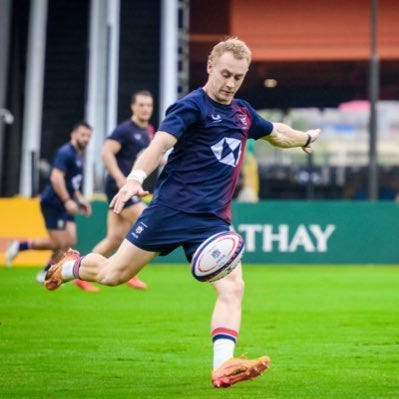
So Matt, what did rugby look like for you before pro rugby?
I was introduced to rugby at a very early age, going to watch Plymouth Albion and Devonport Services in the UK before our family moved to Hong Kong. My dad played rugby when he was younger, so it felt only natural that he shared his love for the game with me by bringing me along.
After moving to Hong Kong, I had my first real taste of playing rugby on a Sunday morning with the HKFC Under-7s, coached by my dad. That marked the beginning of my rugby journey. I went on to play for the club all the way through to the men’s XV team by the age of 17, while also representing Hong Kong at age grade level in both 15s and 7s.
After finishing school, I had a deferred place at the University of Bath and during that period was aiming to break into the Hong Kong Men’s 7s setup. I was then fortunate enough to be selected for a four-week exchange trip to Racing 92 with a friend, as our clubs shared the same sponsor, Natixis. At the end of the exchange, I was offered an academy contract, marking the start of my journey as a professional rugby player.
A quick online search tells me you played mostly for Bedford — how did you get there from Paris?
I was fortunate to spend three years at Racing 92 before departing to sign for Northampton Saints. Once again, I found myself in a world-class environment, learning from some of the best in the game and incredibly grateful for the coaching and support I received.
During my time at Northampton, I was dual-registered with Bedford Blues and, following my spell at Saints, secured a full-time contract with Bedford. Signing for the Blues proved to be a fantastic decision, allowing me to play consistently at a high level in a league that is, in my view, severely underrated and undervalued by the RFU. I went on to spend six years at the club, making 116 appearances across all competitions.
I imagine professional rugby is a fun mix of practice, weights, coffee and putting your feet up until the next game. Is that right?
Life at Bedford wasn’t quite as glamorous as many people might expect professional rugby to be. During the COVID-19 pandemic in 2020, the club transitioned to semi-professional status, requiring significant adjustments from both players and staff. Widespread budget cuts across the Championship impacted clubs heavily and forced many of us to take on second jobs to supplement our income, while training was reduced to three evening sessions per week.
Fortunately, a few teammates and I were supported by the club’s former groundsman, who owned a landscaping business and took us under his wing. It was a stark change from the previous five years of full-time rugby that I had been accustomed to.
Despite the challenges, the experience proved incredibly valuable. It encouraged me to think more deeply about life after rugby and how to make the most of the opportunities alongside a playing career. During my time at Bedford, I was able to complete a full-time business degree while balancing rugby and work in landscaping.
And now you’re back in Hong Kong. How did that come about?
Returning to Hong Kong was a big decision, but ultimately it felt like a natural and straightforward one. It had always been inevitable that I would come home - the only question was when. Having achieved my goal of reaching 100 appearances for Bedford, finishing second in the Championship, and qualifying for the 2027 Rugby World Cup, the timing felt right. With those milestones complete, the decision to return to Hong Kong and join the full-time men’s XV programme in preparation for the 2027 Rugby World Cup became a clear and exciting next step.
I imagine rugby in HK is a little different to England’s home counties.
Rugby in Hong Kong is very different to Europe, with the climate being one of the most significant factors. When the season kicks off, we are often playing weekend matches in temperatures exceeding 33°C with humidity around 90% - a big difference to the winter conditions of the Championship. [Interviewer note: or the summer conditions!]
Another key difference is the playing surface. In the UK, the majority of matches are played on grass, whereas in Hong Kong we train and compete primarily on 4G artificial turf due to weather conditions and limited space. Both factors play a major role in shaping how the game is played and the speed at which it is played.
As a result, rugby in Hong Kong tends to be played at a quicker tempo, similar in many ways to Japan - a style of rugby we aim to replicate in certain aspects of our game. The kicking is probably less of a focus in domestic competitions, as the conditions rarely favour one team over another. Instead, a shared running-rugby mentality exists across teams.
Obviously the big recent news for HKC is qualifying for the next World Cup and being drawn with the minor nations of New Zealand, Chile and hosts Australia. What are you looking forward to in particular?
We are hugely excited to be involved and competing at the highest level. Qualification alone is a massive achievement, but our aim is to go out there and deliver performances we can be genuinely proud of.
We know our pool is extremely challenging, but that only adds to the excitement. In many ways, the draw couldn’t have been better. The opportunity to face the haka at a Rugby World Cup is something very few players ever experience, and to go head-to-head with some of the world’s best on that stage is an incredible challenge we’re really looking forward to. Playing the host nation is another highlight - packed stadiums, intense atmospheres, and a truly special occasion.
Our match against Chile is also particularly exciting. We’ve already played them once and will face them again before the World Cup. They are a strong side with key players throughout the squad, and a team we can take inspiration from based on how they performed at the last World Cup. Our aim is to follow a similar path and create a name for ourselves at the tournament and hopefully have a competitive encounter.
[Interviewer note: what a great reminder to a fan of a Tier 1 nation that there is much more to enjoy than just the possibility of winning, which often leaves us disappointed. I am sure HKC will set out to win every game, but it is equally important to enjoy all that is available.]
How will you prepare, and who are some of the players we should look out for?
Like all teams preparing for a World Cup, our focus will be on working hard and securing as many competitive fixtures as possible. Matches are the best way to improve, and testing ourselves against higher-ranked opposition will only help us grow. The Nations Cup presents a great opportunity to compete against other strong Tier 2 nations and put our preparation into practice.1
With Hong Kong being such a diverse and international place, we’re fortunate to have a wide pool of eligible players - whether born here or having resided here long enough to qualify. Like myself, several players have already returned to Hong Kong in preparation for the tournament.
Two players to look out for who were also competing in the Championship last season are Marcus Ramage of Nottingham and Calum Scott of London Scottish. We were fortunate enough to play against each other in the UK at club level before returning to Hong Kong to represent the national side together.
Other players to watch include our captain, Joshua Hrstich, youngster Lachlan Doheny, who recently moved over from Sydney, Australia after playing in the Shute Shield. We also have a number of key players transitioning from our sevens programme, who will be moving between the two squads in the lead-up to the World Cup.
I am always interested in the challenges people have faced and their hopes (and fears) for the future. What has your journey been like to date?
I’ve taken a fairly unconventional route into professional rugby and, at times, questioned whether I truly belonged - wondering if I was there for the right reasons or simply because it reflected well on the clubs involved. That mindset meant I constantly felt the need to prove myself and show that I genuinely deserved my place.
In a similar way, as we head into the Rugby World Cup, I know there will be people who questinext Son whether we deserve to be competing on that stage. But we earned our qualification, put in the work, and now want to make the most of the opportunity - to be memorable, to deliver performances we can be proud of, and to truly enjoy the occasion.
Like any professional sportsperson, injuries have been one of the biggest challenges of my career. In 2022, I underwent groin surgery and missed out on Hong Kong’s Asia Rrugby Championship campaign. At the time, I wasn’t sure I would return to full fitness quickly enough for the next block of international fixtures, but with the support of my partner, family and club staff, I managed to get back in time.
As I write this, I’m currently injured again after sustaining another groin issue in early November against the Brumbies during our build-up to the Portugal test match. I haven’t been able to jog, run or kick a ball for the past two months and am now working through the recovery process, aiming to be fully fit again by March, play our summer international tests and hopefully be in contention to representing HK 7s in the Asian Games next September.
Finally, if you think past 2027, what comes next?
Beyond the Rugby World Cup, should we qualify for the Olympics, I would like to be in contention for selection with the 7s team. Playing at the Olympics, in my view, represents the pinnacle of sporting achievement.2 The idea of potentially competing in both a World Cup and the Olympics is a lifetime goal - an incredible personal achievement. That said, my current focus is firmly on getting back to full fitness and performing in the next available matches.
Outside of rugby, I’m still exploring what I want to do once my playing career comes to an end. I’d like to stay involved in sport in some capacity, whether that’s working for a union, a team, or another part of the sports industry. I’m open to a variety of paths and believe many of the skills I’ve developed through rugby — teamwork, discipline, leadership — will be highly transferable to a professional setting.
Thanks again to Matt for taking the time to give such thoughtful answers. Hopefully he will be back fit soon and I look forward to seeing how he and HKC develop and perform over the next couple of years.
If you want to follow Matt’s and Hong Kong China’s progress, their twitter profiles can be found here and here.
The Nations Cup is the Tier 2 equivalent of the less useful Nations Championship for Tier 1 nations.
Take that World Rugby :)
This interview format is brilliantly executed! Matt's point about the climate difference (33°C with 90% humidity vs UK winter) realy puts into perspective how much the playing conditions shape rugby styles. The fact that he balanced a business degree, landscaping, and semi-pro rugby during COVID shows remarkable adaptibility. Looking forward to seeing Hong Kong compete in 2027.